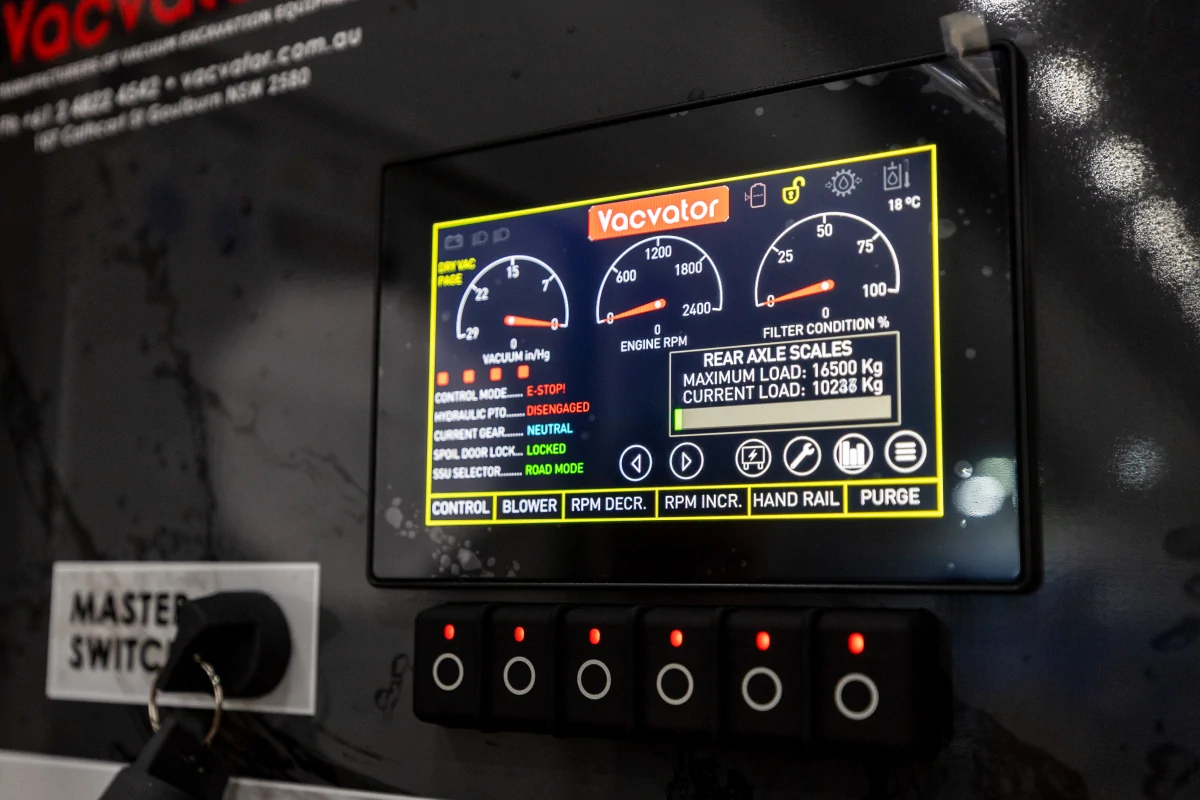
Under GVM but still overloaded? It’s a common and costly issue with vacuum excavation. Many operators assume that if their vac truck’s total weight is under the Gross Vehicle Mass (GVM) limit, they’re in the clear. In reality, you can be under GVM and still break the law because of how weight is spread across your axles. Heavy vehicle compliance isn’t just about total weight; each axle group has its own legal limit.
For vac truck owner-operators and fleet managers, this isn’t just a technical detail, it’s a daily reality. You might start the day legally, only to find by mid-shift that your rear axle group has crept into overload territory. The result? Fines, downtime, and unnecessary wear on your machine.
Issues like axle overloads time and time again don’t just affect compliance, they directly increase the total cost of ownership of a vacuum excavation truck over its working life.
Why axle group weight matters
Running a vacuum excavation truck isn’t like hauling a static load. The load on your axles shifts throughout the job. You might begin the morning well under your GVM, but as you work, water weight goes down as you use your onboard water for digging. Spoil weight goes up as the tank fills with slurry, mud, or debris. Spoil is far denser than water: 1,000 L of water weighs 1,000 kg, while 1,000 L of wet clay can weigh 1,500–1,800 kg.
This hidden trap means a vacuum suction truck that’s legal when it starts the job can be well overweight and illegal when it goes to tip off if it isn’t engineered for the shift in weight. For example, a typical steer axle is limited to around 6.5 tonnes, and a tandem drive group around 16.5 tonnes. If your rear group hits 17 tonnes while your GVM is “legal,” you’re still in breach. If any axle group is over its limit, you’re overloaded. This is why some vacuum truck specifications that look fine on paper still get operators in trouble. If a vac truck’s tank placement or chassis design is off, it will overload an axle long before you reach that GVM limit. Unfortunately, many vac trucks fall into this category, they advertise big tank volumes but not what they can legally carry.
The Cost of Axle Overloads
Being over on an axle isn’t just a legal problem, it’s a business problem. Mismanaging axle weights drives up your total cost of ownership in many ways:
- Fines and Penalties: Overloading fines are steep. One surprise weighbridge inspection can set you back thousands of dollars.
- Extra Dump Runs: If your NDD truck isn’t designed to utilize its capacity without overloading, you’ll be dumping more often. Every extra dump run is time you’re not on a job.
- Risk: Operating overloaded on public roads doesn’t just breach compliance, it puts the operator, the asset owner, and every other road user at risk. It increases stopping distances, affects handling, and exposes everyone to serious legal and safety consequences.
Built for Balance: Engineering Compliance from Day One
The best way to avoid axle overloads is to engineer compliance into the vac truck’s DNA. Vacvator does exactly that when designing our vacuum excavation units:
- Balanced Layout: We position tanks, water storage, and equipment deliberately, so each axle group carries its proper share of weight. As water empties and spoil fills, the load stays evenly distributed.
- Engineered for Heavy Spoil: We design every hydro excavation truck assuming heavy, wet spoil, not just water. That means best possible payloads without tipping the scales.
- Light but Strong Construction: We trim unnecessary tare weight while reinforcing critical areas. A lighter truck means more of your GVM is available for payload without sacrificing durability.
- Proven by Testing: Before a Vacvator truck goes to a customer, we test its weight distribution against real-world scenarios and NHVR standards. We verify each model against real load conditions – full water, full spoil – to ensure every axle stays within its limit.
Smarter Trucks, Safer Loads
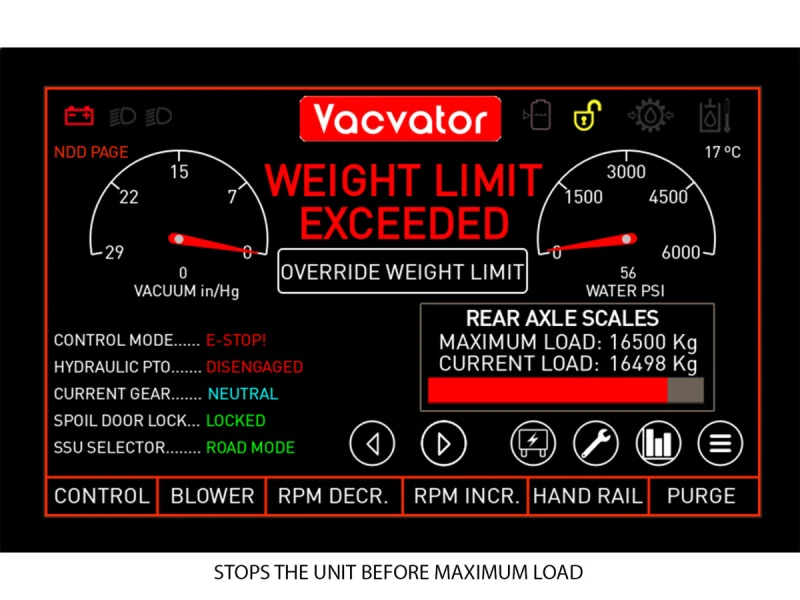
Engineering the truck right is half the battle. The other half is giving you the tools to monitor and manage weight in real time:
- Onboard Scales: Every Vacvator unit features integrated scales with a digital readout via the CAN-Bus operating system. The display in the control panel shows the live weight at all times. This live feedback lets you know when you’re getting close to a legal limit and disable the unit once its legal payloads are reached.
- Overload Alerts: The screen in the control panel continuously displays both the unit’s maximum legal payload and the current load in real time. As the vac truck approaches its legal axle limits, the control system will automatically pause further loading. Operators can override this to safely clear lines and proceed to tip-off, but repeated overrides are recorded complete with time and date stamps. It’s a smart safeguard that protects the asset owner, the operator, other road users and reinforces responsible operation.
- Operator Training & Support: We don’t just hand over our new vacuum trucks and wish you luck. We also train your team on the best loading practices and how to use the onboard system. And with local after-sales support, you’re never on your own.
With these measures, compliance becomes part of your routine. You can focus on the job, confident that your equipment is keeping an eye on the weight.
This approach isn’t just about meeting regulations, it’s about protecting the truck’s total cost of ownership by reducing fines, downtime, and long-term wear.
Compliance Meets Profit: The Payoff
Staying within the rules isn’t about being cautious for caution’s sake, it directly boosts your business’s performance. When your industrial vacuum truck is built and operated for proper axle weights, you get tangible benefits:
- Maximized Productivity: Use your full legal payload for each trip.
- Lower Operating Costs: Fewer trips and balanced loads save fuel and reduce wear on the truck.
- Built to Be Kept: You rarely see second-hand Vacvators on the market. Owners hang onto them because they’re reliable, easy to operate, and built to deliver day in, day out. They earn well, cost less to run, and stay compliant without the headaches. And when it is time to upgrade, they hold their value. Buyers know they’re getting a proven, productive unit that still has years of work left in it. In short, a legally loaded vacuum excavation truck is a more profitable truck. A legal payload isn’t just a box to tick; it’s a competitive edge. Vacvator trucks are built to give you that edge from day one.
At Vacvator, our approach is simple: design it right, build it tough, and back it up. The result is a truck that protects your livelihood as much as your compliance record. It’s compliance by design and profit by performance.
All of these factors combine to lower the total cost of ownership while increasing the truck’s earning potential over time.